
Sermons
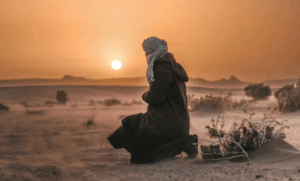
November 2, 2025 (Proper 26)
“You must walk your lonesome valley…”
1 Kings 19:1-18
Now I lay me down to sleep,
I pray the Lord my soul to keep;
if I should die before I wake,
I pray the Lord my soul to take.
Children of an earlier era learned to say this prayer at bedtime. In those days, before vaccinations and antibiotics and so many other modern advances, death was a much closer reality than it sometimes is for us—especially for our children, whom we understandably want to shield from such things whenever we can.[1] So perhaps the prayer was comforting in that earlier time. Nowadays, people find it terrifying.
When I was young I remember reading it in one of the Little House books, and taking it as my own bedtime prayer.[2] And I spent a great many sleepless nights in fear that I might, indeed, “die before I wake.” I really didn’t want to.[3]
It was a completely different prayer Elijah said as he lay himself down to sleep under a solitary broom tree in the wilderness. “Let me die before I wake,” he said. “I’ve had enough.”
It’s a pretty surprising prayer, given that just days before, Elijah was on top of the world. He had defeated the prophets of Ba’al—actually, God had defeated them, with an astonishing display of power instigated by Elijah—and everyone knew that the Lord was truly God.
But Queen Jezebel was herself a devotee of Ba’al, so Elijah’s triumph did not please her at all; and she swore to take Elijah’s life within 24 hours. He knew that was no idle threat, and he found himself crashing down from the top of the world into a dark, lonesome valley of burnout. Suddenly the reality that he had stood utterly alone in challenge against 450 prophets of Ba’al set in, and he could think of nothing else.
I might have won that battle, he may have thought, but I’m losing the war; I’m the only one left who is faithful to the Lord,[4] and once I’m gone, that’s it. Why fight any more? So he lay down under the broom tree, and prayed that he might die in his sleep.
After a time, though, he wakes to God’s messenger urging him to eat, so he will be strengthened to continue his journey, his retreat, into the wilderness and eventually to the holy mountain of God, called in this story Horeb, but in other places Sinai. When he got there, he set up camp in a cave.
And the next morning God spoke to him. “What are you doing here, Elijah?”
He replied, “I have been faithful to you my whole life; I have zealously carried out the ministry to which you have called me. But nobody else cares anymore—I’m it. I, even I only, am left to serve you. Nobody else cares about what I care about. All the saints are dead.”
So then God tells Elijah to prepare for God to pass by—just as God had passed by Moses and declared his Name on that very mountain so many years before. But when all the usual, expected manifestations of God’s presence happen, one after another, Elijah is again disappointed.
God was not in the wind, even though the oldest of the Psalms, the 29th, uses the metaphor of a powerful windstorm to describe God’s voice. God was not in the earthquake, even though earthquakes shook Mount Horeb (Mount Sinai) as the Israelites waited at the foot of the mountain for God to speak to them.[5] God was not in the fire, even though fire had signified God’s presence to the Israelites as they had traveled through the wilderness from Egypt to the Promised Land.[6]
After these wonders, there is emptiness. No sound, no distraction, nothing to drown out the insistent muttering of Elijah’s despair. And that’s when he realized God was present.
Again God asks, “What are you doing here?”
Elijah repeats what he had said earlier: I’m all that’s left of your faithful people—it ends with me, and then Ba’al will win. And my days, as you’ve heard from the queen, are numbered.
God says, no, all is not lost. He tells Elijah to go anoint a couple new kings, and to name his successor. Then he says, Don’t worry about the future. There are still seven thousand in Israel who are faithful to me. Seven thousand saints, who have remained holy, remained set apart from the rest, for God’s sake. They will continue to call on me and resist the siren song of the Ba’als.
In the church calendar, yesterday was All Saints Day. In many churches, including ours, this weekend we remember and honor those who have gone before us, on whose shoulders we stand. Even if our churches don’t have such remembrances, we might spend time preparing and celebrating the night before All Saints Day—Hallowe’en.
In the Lutheran tradition, October 31 has another meaning, too: it’s the day when, more than five hundred years ago, a professor by the name of Martin Luther posted a list of discussion topics on the door of the church in his university town. He posted them there because he knew they would be seen by lots of people the next day, since it was All Saints Day, a day when lots of people would gather there for worship. But he also had copies printed, which circulated far and wide. There could be no suppressing his dissent, as had been done with some who’d asked similar questions to his before the printing press revolutionized communication.
That day, October 31, 1517, was the day when there could no longer be any denying that the world was in upheaval.[7] With Martin Luther’s dissent, the authority of the church’s teaching and hierarchy was called into question, and it would be many years before a new authority—sola scriptura, Scripture only—was accepted.
Now, five centuries later, sola scriptura has itself been called into question[8] as the final authority on matters of faith and life. Many who have relied on that authority as the foundation of their lives and their relationships with God are discouraged, terrified, wondering if all is lost.
And so we go to the wilderness, crying out to God to put something solid back under our feet. We feel alone, as our congregations get smaller and older and we feel more and more alone in our quest to follow Jesus faithfully. We wonder if there are any saints left, if there will be anyone after us who knows God and seeks to follow Jesus.
And to us, as to Elijah, God speaks, and says: I Am, and there are still many who seek my face. Tomorrow will be different from yesterday—it always is—but do not worry about what the future holds, because I still hold the future.
[1] We might argue that there’s a fair amount of denial and avoidance of death that isn’t all that healthy, but we’ll deal with that at another time.
[2] Although she doesn’t mention it in her books, Laura Ingalls Wilder did have a little brother, Charles Frederick Ingalls, who died in infancy; he is buried at Burr Oak, Iowa, where the family was living when he died.
[3] I am, of course, aware that infants and young children do still pass away in their sleep, and my heart goes out to their families. But infant and child mortality is, thankfully, much lower nowadays than in previous times. Walking through the older sections of cemeteries can be very sobering.
[4] Even faithful Obadiah, who’d once hid 150 of God’s prophets from Ahab’s and Jezebel’s wrath, was losing his nerve (1 Kings 18:1-16).
[5] Exodus 19:18
[6] Exodus 13:21-22; see also Numbers 9:15-23.
[7] The upheaval had begun years before, perhaps at the time that the Black Death decimated Europe, which rendered the feudal system impossible to maintain.
[8] Some believe this began with Charles Darwin’s publication of The Origin of Species, but it could also be argued the Enlightenment, beginning in the 17th and 18th centuries, set it into motion. It’s been suggested that the last dominos to fall, so to speak, have to do with the place of women and LGBTQ+ folks in society and church leadership, which could be why they have sparked so much consternation.