
Sermons
March 8, 2026 (3rd Sunday in Lent)
“The seas grow calm at thy command…”
John 6:16-21
The people who study such things tell us that most people they’ve asked have said they want sermons that offer concrete ways we can apply a particular message to our lives. So, in the interest of giving the people what they want, I offer this:
If you are on a boat and the water gets choppy, you might see Jesus walking toward you on the water. If so, don’t be afraid, just let him onto the boat. Once you do that, you’ll be at the shore, and the storm won’t be a problem for you anymore.
There you go. Practical advice.
But is that it?
Not every Biblical text lends itself to such a wooden interpretation. Most passages in John are in that category.
With that said, though, I do think there’s a practical application here, just maybe not one as unrealistic as this one. I mean, how many of us are going to be in boats on the Sea of Galilee in the midst of one of the storms that frequently hit that body of water? Would we find ourselves in a boat on, say, Lake of the Ozarks and face the same kind of situation? I don’t know; I don’t know if Lake of the Ozarks would ever behave like the Sea of Galilee does. And the chance of Jesus literally coming across the water as if he were walking across your living room is pretty slim, even if you were to find yourself in the midst of such a storm.
Let’s look at the text for a moment, and see what it says that might be applied to our everyday lives.
First, contrary to what I said in the newsletter, only three of the four Gospels include the story of Jesus walking on the water. Luke doesn’t, even though he does include the feeding of the multitude with which the story is paired in the other three. I’m not sure why Luke leaves it out, and it probably doesn’t matter for today’s purposes; I just wanted to correct the record.
Next we’ll put the story in its context.
This takes place the evening after Jesus has fed a multitude with one kid’s lunch of a little bread and fish. The people are so impressed with the meal that they try to take Jesus and make him king—they recognize that he is the One they have been waiting for, and in their minds that One is to be king, so they decide to force the issue.
He’s having none of it—one thing we find in all four Gospels, although John’s Jesus never undergoes a temptation in the wilderness, is that Jesus has no interest in taking up political power. Fred Craddock noted in a sermon on the temptations that we can imagine the world being a better place if he had—what kinds of injustice, oppression, violence, and poverty could he have ended? But earthly political power requires certain compromises that were not in keeping with what Jesus knew he came here to do.
Paul tells us in Philippians that Jesus had greater authority than any earthly leader—indeed, he was “in the form of God”[1]—but he laid that all aside to come to earth as a servant, so totally obedient to God’s will that he was put to death on a cross, which broke the power of sin and death over all of humanity. Jesus did not want earthly authority; he did not want to be a king. So he went up into the mountains to get away from the crowd.
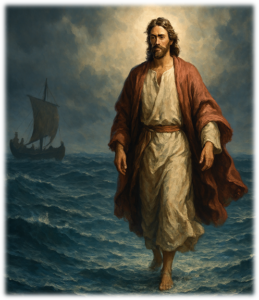
Meanwhile, the disciples took the twelve baskets of leftovers and got in a boat. Jesus didn’t go with them, but when they were in the middle of the lake and a ferocious wind kicked up, they looked out to see him walking across the lake as though it were a well-trod path.
I can understand why the disciples were terrified by that. People don’t just walk across the water…although I remember that Carrie and I were accused of coming sort of close to it when we were swimming at the lake and a snake came out from under the neighbor’s dock. (The snake was probably more scared of us than we were of it, given how we were screaming and splashing and carrying on.)
When the disciples saw Jesus out there, they may well have thought it was a ghost, or that they had eaten some bad fish and were all hallucinating.
Did you know that “Do not be afraid” or some variation thereof is the most frequently issued commandment in the Bible? Just about any time an angel shows up that’s the first thing they[2] say.[3] And according to the prophets, that’s often God’s message to us.[4] It’s what Jesus says to the disciples as he walked toward their boat on the whitecapped lake.
They might have been encouraged by that, except for the other thing he said. We lose it in translation from Greek to English. He says, “It is I; do not be afraid.” In Greek “it is I” is egō eimi—literally translated, it says, “I am.” The disciples would have heard that and remembered a crucial detail from their Scriptures.
Back in Exodus chapter 3, Moses encounters God in a burning bush on Mount Sinai, where God tells Moses he’s going back to Egypt to make Pharaoh set his people free from enslavement. Moses argues with God about this; one of his objections is, “I don’t know your Name. Whom shall I tell the Israelites has sent me to free them?”
God’s reply is, “I Am Who I Am. You tell them I Am sent you.”[5]
Jesus is out there walking on the surface of the lake, and he says, “I Am; do not be afraid.” And that goes to John’s overall message, which he gave away at the very beginning of the Gospel: “In the beginning was the Word, and the Word was with God, and the Word was God…And the Word became flesh and dwelt among us…”
There’s a little bit of disagreement about how to number the seven signs in John’s Gospel. Some call Jesus’ walking on water a sign in its own right; others put it with the feeding of the multitude, so that the seventh sign is Jesus’ entry into Jerusalem. I agree with the first group. This passage describes, in this way of thinking, the fifth sign, so the final one is the raising of Lazarus; then the panicked conversations of the religious leaders constitute the aftermath of that sign, and that leads to Jesus’ death.
The point of all the signs recorded in the Fourth Gospel, John tells us toward the end, is to show us who Jesus is, so that we will come to believe in him, and therefore have eternal life.[6] It couldn’t be more obvious than it is here in the fifth sign, in which Jesus clearly connects himself to the Name God revealed to Moses during their conversation at the burning bush on Mount Sinai.
But what does this sign mean for us? Is there an application, or do we just hear it and say, “Yes, Jesus is God; we see this because he refers to himself as “I Am,” and that’s all?
Well, it surely can’t be that Jesus will come walking across water if we find ourselves caught on a boat in a storm. But there are plenty of storms that we run into over the course of our lives.
Some of them are literal storms. This building we’re in right now attests to that. And you’ve probably seen the video of the TV news reporters and their cameraman who took refuge under an overpass on the Kansas Turnpike during the tornado outbreak of April 26, 1991. One of those reporters was Gregg Jarrett, who is on one of the conservative news channels now. He was on camera only minutes after that video was taken; he was shaken up and a bit damp and muddy.
Just a couple nights ago, the same storm system that hit us with wind and rain and lightning unleashed tornadoes in Michigan.
But of course there are other kinds of storms, although not literal weather events, that we face in life. We deal with economic upheaval, sickness and injury, death of loved ones, violence and tragedy. Life, as Scott Peck told us at the very beginning of his best-known work, The Road Less Traveled, is difficult.
In this fifth sign in John’s Gospel, we find a source of great strength and hope when our way is hard. Remember Matthew’s commentary on the angel’s announcement to Joseph, pointing out that Jesus’ birth will fulfill the prophecy in Isaiah 7:14: “…the young woman is with child and shall bear a son, and shall name him Immanuel,” which means “God with us” or “God is with us.” Jesus is Immanuel, God with us. God is with us.
If we feel like we’re in the midst of a storm, if our lives are out of control, if we’re going through hard times, terrible situations, loss and tragedy, God is with us.
“I Am; do not be afraid.”
[1] Philippians 2:6
[2] Angels, according to tradition, do not have gender.
[3] See, for instance, the birth narratives in Matthew 1—2 and Luke 1—2.
[4] See Isaiah 43:1; Jeremiah 1:8.
[5] Exodus 3:14
[6] John 20:30-31