
Sermons
January 4, 2026 (2nd Sunday of Christmas)
“He’s here.”
John 1:19-34
One of the things I like best about the Narrative Lectionary, although I do have some criticisms, is that it’s on a four-year cycle instead of a three-year cycle like the Revised Common Lectionary and the ones specific to particular traditions, like the Catholic and Lutheran churches.
In all the lectionaries, each year focuses on one particular Gospel: in the RCL it’s Matthew in Year A, Mark in Year B, and Luke in Year C. The Fourth Gospel is sprinkled in here and there, which never gives us a chance to hear from John at length. But in the Narrative Lectionary, each Gospel gets its year, and that Gospel is fully explored in the season between Christmas and the first couple Sundays after Easter.
This is Year 4 of the Narrative Lectionary, so we get to go through the Gospel of John more or less in its entirety.
The Prologue to the Fourth Gospel, which we heard last week and also as we prepared to light candles on Christmas Eve, is John’s poetic meditation on the meaning of Jesus’ life, death, and resurrection.
I can’t imagine I’m the first to think of this, but it seems to me the whole Gospel of John can be thought of as an expansion on the first few verses of Isaiah 55, most particularly verses 10 and 11:
“For as the rain and the snow come down from heaven,
and do not return there until they have watered the earth,
making it bring forth and sprout,
giving seed to the sower and bread to the eater,
so shall my word be that goes out from my mouth;
it shall not return to me empty,
but it shall accomplish that which I purpose,
and succeed in the thing for which I sent it.”
Remember how the Fourth Gospel begins:
“In the beginning was the Word,
and the Word was with God,
and the Word was God…”
And then look ahead to the last words of Jesus on the cross in John 19: “It is finished”—or, better, “It is accomplished.”
(There are also allusions to the first part of Isaiah 55 later in the Gospel, in chapter 6, with the feeding of the multitude; and chapter 7, where Jesus speaks of himself as living water. We’ll get to those down the road a ways.)
But here in the first chapter of John’s Gospel, we meet another character, briefly—also named John. (Nowhere in the Gospel does it actually tell us the author’s name is John; that’s tradition—not John the Baptist but John the son of Zebedee, thought to have been the youngest of the Twelve. This first bit might be less confusing if tradition had settled on someone else, like maybe Lazarus, or even the Magdalene…but the name we have is the name we have.[1])
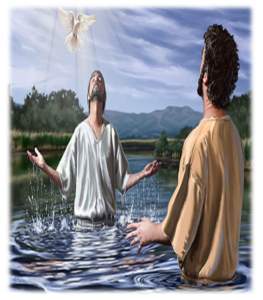
We actually meet him in all four of the Gospels, and they all say John the Baptist baptized Jesus. In the Fourth Gospel we are not given a narrative of that event; the Baptist simply says that, in retrospect, he knew Jesus was the Son of God, the one his people had been waiting for, when he came up out of the water and the Spirit descended like a dove and remained on him.
We will learn in next week’s reading that some of Jesus’ original disciples had previously been John’s disciples. But John was not the Messiah, or the return of Elijah, or the “prophet like Moses” predicted in Deuteronomy 18:15. He identified himself with the voice crying out in Isaiah 40, which we just read responsively—the voice that proclaimed the Lord’s coming to set the people free from exile.
Then, the next day, he demonstrated how he fulfilled that role. He saw Jesus and said, “He’s here!” The one we’ve been waiting for, watching for, longing for—the Lamb of God who takes away the sin of the world.[2] And he explains that his baptism was meant to prepare people to receive Jesus once he arrived. He says that God had told him what to look for: “‘He on whom you see the Spirit descend and remain is the one.’” I saw that when Jesus came up out of the water, and that’s how I know he’s the Son of God.
He’s here.
Many scholars think this is put here to downplay John the Baptist’s importance. It seems that a sect formed around him, and there may have been some rivalry between them and the Jewish sect that eventually became the Christian church. All four Gospels include some language indicating that John was subordinate to Jesus, even though all four Gospels also tell us Jesus was baptized by John.
Yet many churches focus on John the Baptist for at least one Sunday out of the year—oftentimes the third Sunday of Advent—and then again at the Baptism of the Lord, which is the Sunday after Epiphany. That, of course, is not how the Narrative Lectionary organizes things; John’s version of the baptism is assigned for today, when Epiphany has not happened yet.
And even though we do not follow John but Jesus, we have something to learn from John anyway. (We won’t get into the content of his sermons, which isn’t found in the Fourth Gospel; suffice it to say he didn’t have the gifts of tact and diplomacy.[3])
John knew Jesus. Luke tells us they were cousins; we don’t hear that in the Fourth or any of the other Gospels. But when he baptized Jesus, he recognized something about him, whether or not they had known each other since childhood. This was the Christ, the Messiah, the one they had waited for.
And where it’s human nature to want to hold onto our own power and influence, even when someone comes along with their own, possibly more compelling, power and influence, that’s not what John did. He pointed the way to Jesus, even though it meant losing some of his own followers.
John pointed to Jesus. He spoke and acted in such a way that others would come to know and believe in Jesus.
I wonder how we could do the same in our own lives, wherever we are and whatever we’re doing.
[1] Some scholars do cryptically suggest that “the disciple whom Jesus loved,” apparently the Evangelist’s way of referring to himself, refers to Lazarus, given that in John 11:3 he is referred to as “he whom you love” when the disciples report his illness to Jesus. I don’t know of anyone suggesting Mary Magdalene could be the author; that’s merely my own flight of fancy—although there are some who find evidence in Luke that that Evangelist could have been a woman.
[2] Note “sin,” not “sins.” He’s speaking, as does Paul, not of forgiveness of individual bad behavior, but of a pervasive force that makes it difficult if not impossible to follow the will of God and ensures that even good actions have unintended negative consequences, that leadership frequently requires compromising principles, that groups often magnify members’ bad behavior to demonic proportions.
[3] See Matthew 3:1-12.