
Sermons
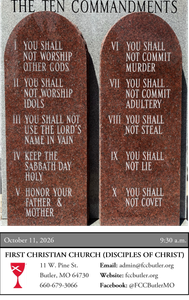
October 11, 2026 (Proper 23)
Our Ears Are Burning
Exodus 19:3-7; 20:1-17
Seems like fairly regularly we hear about somebody, somewhere, trying to get a law passed requiring school classrooms, courthouses, and other public places to post the Ten Commandments. And whenever that happens, some commentator or comedian decides to have a little fun with the instigator of the law. “You want the Ten Commandments posted; can you name them?” And almost inevitably, they can’t. As a general rule, they’re able to name three easily—don’t murder, don’t lie, don’t steal—and then maybe one or two others, honor father and mother, perhaps, or don’t covet; but very few actually manage to list all ten.
I’m curious: what is it about the Ten Commandments that makes people want them posted on courthouse and classroom walls? And what is it about these particular ten commandments, as opposed to the other six hundred in the Old Testament, that keep them revered by Christians when we don’t believe we’re called to follow any of the others? On the one hand, Jesus said he didn’t come to abolish the Law—by which he means the Torah, the Old Testament Law—but to fulfill it, and that not even one letter, not even one stroke of the pen, of the Law would pass away until “all is accomplished.”[1] But on the other hand, the author of Ephesians says Jesus did abolish the law, at least as a barrier between Jews and Gentiles. And it was very early in the history of the Christian faith that we determined Gentiles—non-Jews—who became Christians did not have to become Jews, and follow Jewish Law, before they could join the church.[2]
I think it’s fair to say that we Christians have a complicated relationship with Torah, the Old Testament Law. We place great importance on some of the commandments, such as (depending on our social, political, or theological point of view) the ones about taking care of the poor or prohibiting certain sexual behaviors; but we consider others to be completely irrelevant, like the commands against eating pork or shellfish, or wearing clothing made of mixed fibers. (Do your jeans have a little spandex in them to make them more comfortable? If so, you’re breaking the Law, according to Leviticus 19:19.)
And we revere the Ten Commandments as much as anything Jesus ever said. I wonder why. Why are they so important to us, even if we can’t name them?
It can’t be the content—plenty of the people who want them conspicuously posted all over the place can’t name them. Most of us, if pressed, can come up with some of the last ones, the ones that are common sense—don’t murder, don’t steal, don’t lie, don’t commit adultery. But those are, as I said, common sense—plus which, most of them are already the law of the land in most places. And where would our economy be if we truly followed the tenth commandment, the one about not coveting?
But still there’s something that causes us to revere the Ten Commandments. What is it?
This desire to post the Ten Commandments in public spaces—courthouses, schools, town squares—tends to come up not when everything is going well and we’re feeling good about ourselves, but when we’re anxious or, as the polls word it, our country feels like it’s “off on the wrong track.” It’s like we think just having them in front of us would make everything better, even if we can’t, for the most part, name all ten. I suspect there’s something else going on; and I think that “something else” can be found not in the commandments themselves, but in their context, especially in what comes right after them in the book of Exodus.
We know—because most of us have seen the Cecil B. DeMille version—that the Ten Commandments were given to Moses and the Israelites at Mount Sinai. In the chapter right before the Ten Commandments appear, part of which we read this morning, God says he’s going to come down and give the commandments to the people directly. They are told how to prepare, and they’re instructed where to stand so that they aren’t harmed by God’s Presence.
And then, at the beginning of chapter 20, God begins to speak, and what he says are the Ten Commandments. That takes seventeen verses.
In verse 18, we learn that the experience was so terrifying that the Israelites immediately tell Moses, “From now on, you talk to God, and tell us what God says; but we can’t handle speaking to God directly ourselves.”
So all other commandments are given to Moses, who passes them along to the people. From that point on, all further communication from God is mediated. It comes not directly from God, but God speaks through someone else.
This leads me to wonder…
The call to post the Ten Commandments in public space seems to grow louder in times when we are the most uncertain, anxious, fearful, when life is the most difficult. I just don’t think what we’re looking for is a universal set of agreed-upon rules that, if everybody just knew them, we would obey them and the world would be perfect. I think we know better than that—and therefore what we’re actually trying to find is something else.
The context tells us that, of the 613 commandments in the Old Testament, all but these ten are mediated—they come from God through Moses. But the Ten Commandments were spoken directly by God to the people of Israel.
Even though it was terrifying to Israel, I wonder if the reason we still hold these ten in such high esteem is precisely because they came directly from God, not through anyone else. And perhaps the reason we clamor to have them prominently featured is because we hope that, in a difficult time, God just might speak to us again.
[1] Matthew 5:17-18. If this were from John, we might be able to say credibly that of course the Law is now abolished, because Jesus’ last words in John 19:30 are “It is finished”—or, in another possible translation, “It is accomplished.” But this is Matthew, not John, so is it appropriate to make the connection between the two texts?
[2] This ruling came from the very first church council, as recorded in Acts 15.