
Sermons
September 13, 2026
“…the fire next time”?
Genesis 9:8-17
I told you last week about Mike’s fascination with YouTube videos about the construction of the Brooklyn Bridge. Lest you think I’m immune to such things, I also have topics I will watch endless videos about.
One is the archaeology of the British Isles. That goes back to the time after I broke my arm, when I was pretty limited in what I could do, and soon afterward COVID sent us all home with a fair amount of time on our hands. I discovered that the entire twenty-year run of the English program Time Team had been posted to YouTube, and I watched them all. The British Isles have been continuously inhabited for thousands of years, and each culture who lived there left behind evidence. The trained eyes of archaeologists can see this evidence when regular folks just see a little bit of difference in soil color, a bump in the ground, or a rock.
My interest in British archaeology led to a side interest. Seems that, during the last Ice Age, there was dry land in the area between Britain and the European continent, which scientists today call “Doggerland.” It doesn’t happen terribly often—because Doggerland is now underwater—but people do occasionally turn up artifacts from the people who once lived there.
Underwater surveys have allowed experts to understand what happened to Doggerland. When the Ice Age ended and the glaciers began to retreat, it started out as a slow process. Shoreline disappeared a few inches at a time. River channels opened up and widened. And then, similar to what happened in Nepal and Tibet a few weeks ago, a gigantic piece of the melting glacier broke off and fell into the sea, leading to a massive tsunami, which swamped what remained of Doggerland once and for all.
All over the Western world, there are legends about islands and peoples who sank beneath the sea. (I imagine there are in the Eastern world, too, but I just don’t know a whole lot about the history or folklore of that part of our planet.) Atlantis is one of the most familiar ones, courtesy of all kinds of pseudoscientific TV programs that have aired over the years. A lot of legends have at least a kernel of fact behind them, and the one about Atlantis (and Hy-Brasil, and probably other “lost islands” I don’t know the names of) probably isn’t an exception.
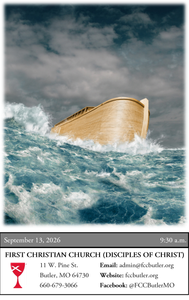
I imagine a lot of the legends about catastrophic floods and sinking islands and such probably have roots in the changes that happened as the Ice Age ended. And it’s not unthinkable the story of Noah’s Ark has similar roots.
Even if it doesn’t, there are other situations that lead to massive flooding; maybe over smaller geographical areas, but they could still give rise to legends. And in the folk process, the story about a flood that affects a small area, such as the Ancient Near East, can be embellished until that flood eventually is described as covering the entire earth.
Now I don’t mean by saying all this to give the impression that the story of Noah’s Ark has no value for us. There’s lots of stuff in the Bible that may have originated in mythology or folklore; that doesn’t mean it has nothing to say to us about who God is or how we live as God’s people.
Today we begin the Narrative Lectionary year. In other years we start with Genesis 1, in which God speaks the world into existence over seven days;[1] or Genesis 2, the story of the Garden of Eden and the first humans God put there. But this year we start with Noah, and to be specific, we start with the end of the Noah story.
The story might have roots in legend, and it might have parallels in the folklore of other cultures of the Ancient Near East, it was put in the Bible for a reason. Scholars think the first five books of the Bible, which are known as the Torah, or the Pentateuch, came together in the form we have today during and after the Babylonian Exile.
In the sixth century bce, the Babylonian Empire conquered the nation of Judah and deposed the Davidic king who sat on the throne in Jerusalem. They burned the city and destroyed the Temple, and they carried off any treasure that might have still been there, most likely including the Ark of the Covenant.
This was probably the main, formative event in the life of the people who came to be known as Jews.
The people had become complacent when they lived in the land they believed God had given them. They took the exodus, the time when God rescued them from slavery in Egypt and put them on their own land, for granted. They got lax in their worship, sometimes forgot to give thanks, just counted on God always taking care of them no matter what, no matter how they behaved, no matter what foreign gods they ran after. Prophets speaking for God warned the people that their complacency and their idolatry were going to have serious consequences, but the people did not listen.
Then came the exile. The poorer folks were left on the land to fend for themselves, without the king’s protection, such as it was, scratching out a living the best they could—and probably wondering where God could be now that the Temple was destroyed. The wealthy folks, the royal family, the scholars and the priests were carried away, treated brutally, made to live in ghettoes as third-class citizens in a foreign land.
Like the poor folks who were left behind, they also had a crisis of faith, wondering whether God had forgotten them, abandoned them, given them over to their enemies. They tried to figure out why, and there was a conversation of sorts between two different opinions on that question. One side, which eventually found its way into our Bible as the books of Samuel and Kings, as well as Deuteronomy and some of the prophets like Jeremiah, believed the people from the king on down had been unfaithful to God, had forgotten, had done what was evil in God’s sight. Another side, found in places like the 44th Psalm, thought they might be getting some punishment they didn’t deserve.
Both sides feared that God had abandoned them; one side thought it was deserved, but the other believed it was unjustified.
As the years wore on in exile, the people began to believe they needed to remember who they were, to remember their stories, their laws, the history of how God had dealt with them and how they had been called to respond. They collected the stories, laws, traditions, rituals, and such, and began to shape them into what we have today as the Torah, the Pentateuch, and perhaps the rest of the Old Testament as well. They began to observe Sabbath again, and part of their Sabbath practice was to study the texts and laws and stories they’d been able to put together. This may have been the beginning of the institution we know today as the synagogue.
In the process the people began to realize that, even though the Temple was gone and they no longer lived in the Promised Land, God was still with them, hadn’t forgotten them, hadn’t abandoned them. And when they put together all the stories about Noah and his family, little bits and pieces—at least two versions of the story, if you look at it really carefully—they put a little bit of interpretation in with them.
The text we read today is the conclusion of the part of the Noah story that includes the flood and the ark. There is a little more that comes after it, but this is the part we most remember. Scholars think this text was brought into its final form by the priests in Babylon, who were very concerned about covenant and ritual. You heard how repetitive the passage was. Luckily it’s fairly short or we might get bogged down in how God seems to say the same thing over and over again.
Ultimately, what the priestly writers wanted to get across is this: that nice little story we’ve told our kids for centuries about how the rainbow came to be is more than that. It’s a story that points to a sign, a sign we can see everywhere, not just in the Promised Land, a sign that God hasn’t forgotten us. Not only do we see the rainbow and remember, but God does too.
God remembers the promise always to be with the people, and never again to destroy the earth even though he had no illusions that the flood had wiped out human sinfulness. It’s a promise that reveals God’s grace, God’s steadfast love and faithfulness that endure even though our own love is not steadfast and we aren’t always faithful.
But beginning with the Second Letter of Peter, we have a troubling interpretation. The writer says that while the world was once destroyed by a flood—and he conveniently leaves out the part about the rainbow and God’s promise never again to destroy the world— “the present heavens and earth have been reserved for fire…”[2] In other words, as the spiritual says, “no more water, but the fire next time.” God might have promised never to destroy the world with water again, but God never said he wouldn’t destroy it in another way.
Now I am not sure that interpretation of 2 Peter 3:7 is right; read in its context it may be talking about something else.
There is a very real tendency in human nature to be suspicious of free gifts, even from God. The grace of God is so enormous, so hard to wrap our minds around, that this human tendency kicks in, certain there’s some meanness in there, some limit to God’s grace. And even if we believe we ourselves are totally deserving of God’s favor, we are certain that others aren’t, so we tend to relish the idea of them getting what’s coming to them. In other words, we hold onto God’s promise not to destroy the earth with a flood—but we also eagerly anticipate sinful others being caught up in “the fire next time.”
I think that misses the point of the promise God makes in Genesis 9. After the flood, God has no illusions that he has managed to do away with human sinfulness. But the promise isn’t conditional, like the promise to David centuries later.
In that covenant, God says a descendant of David’s will sit on the throne in Jerusalem “forever”—as long as they are faithful to God’s commandments and don’t run after foreign gods. The failure of David’s descendants to be faithful to God’s commandments and their tendency to run after foreign gods—or at the very least to tolerate their people’s running after foreign gods—was interpreted by some as the reason why the Babylonian Empire destroyed Jerusalem and ended the Davidic dynasty.
There is no such condition in the covenant God makes with Noah after the flood. “I’m putting my bow in the clouds”—and the bow here is the kind that launches arrows—“and when I see it, I’ll remember that I promised not to destroy the earth again.” The way that “bow”—the rainbow—is curved when we see it from the earth, if it had an arrow in it that arrow would be aimed not at us but at God. So the sign of the promise is like when we might say, “May God strike me dead if…”—except God is saying, “May I strike me dead if I should ever be tempted to destroy the earth again.”
That’s a God who would rather die than have any of us lost…just like God showed us in Jesus Christ.
[1] It appears in Genesis 1:1—2:3 that the actual work of creation takes place over six days, but at the very end of the account we learn that the work is not considered finished until God rests on the seventh day.
[2] 2 Peter 3:7