
Sermons
August 23, 2026 (Proper 16)
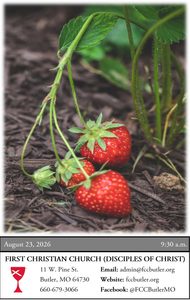
“You can’t get strawberries from a poison ivy vine.”
Matthew 7:15-20
Every now and then when I was in college and living in the dorms, we would go into the lounge and find someone had tuned the television in there to the Christian channel. (There was only one on our system then.)
One of their programs was set up like a news broadcast, with two anchors sitting at a desk and a map of the world behind them. It was called This Week in Bible Prophecy. The anchors would review some of the week’s news stories and try to relate them to the weird imagery found in the book of Revelation and the weirder parts of Ezekiel and Daniel. They would speculate about whether it was time for the Rapture of the Church, or what major world figure was the Antichrist. One of them would inevitably sigh longingly and say that it was getting so bad out there, surely it couldn’t be much longer before the Second Coming.
Is that what comes to your mind when you think about prophets and prophecy? Is Biblical prophecy only about predictions of what will happen in the end-times? Or do prophets speak about other things in the Bible—and if that’s the case, is it possible there might be prophets among us even today, speaking for God?
We probably need to start by figuring out what it is that a prophet does.
The prophets in the Hebrew Bible—Isaiah, Jeremiah, Amos, Hosea, and so forth—weren’t all that concerned about the end-times. Their focus was on their time and place, looking at what was going on around them and interpreting those events in light of what they believed God expected of the people.
Walter Brueggemann said that the job of the prophet is “to nurture, nourish, and evoke a consciousness and perception alternative to the consciousness and perception of the dominant culture around us.”[1] In other words, a prophet sees what’s happening and what the mindset of the people is, and tries to get them to look at the world in a different way. We can see this taking place in the prophetic books of the Hebrew Bible.
In the early chapters of Jeremiah, he notices that the people are generally pretty complacent. Their land seems to be pretty prosperous, and they believe that God will always protect them because they have the “temple of the Lord” in their midst. They appear to believe they can do whatever they want, and nothing bad will happen because they are God’s people and worship at the temple of the Lord. Jeremiah says, no, it ain’t necessarily so.[2]
When the people have lost their land and been sent into exile, and they sit in despair because they’ve come to believe this catastrophe comes upon them as punishment for their sin, and that God had abandoned them, the Second Isaiah comes and says,
Comfort, O comfort my people, says your God…
In the wilderness prepare the way of the Lord,
make straight in the desert a highway for our God.
Every valley shall be lifted up,
and every mountain and hill be made low;
the uneven ground shall become level,
and the rough places a plain.
Then the glory of the Lord shall be revealed,
and all people shall see it together,
for the mouth of the Lord has spoken.[3]
When the people were overwhelmed by the task of rebuilding the temple after they returned from exile, not to mention their lack of resources to rebuild it to its former glory, and they had simply stopped working, the prophet Haggai spoke this word from God:
…take courage, O Zerubbabel…take courage, O Joshua, son of Jehozadak, the high priest; take courage, all you people of the land, says the Lord; work, for I am with you, says the Lord of hosts…My spirit abides among you; do not fear…Once again, in a little while, I will shake the heavens and the earth and the sea and the dry land; and I will shake all the nations, so that the treasure of all nations shall come, and I will fill this house with splendor, says the Lord of hosts.[4]
When the dominant culture is complacent, the prophet is to shake them up and make them realize things need to change. If the dominant mood is despair, the prophet’s job is to give hope. If the people are overwhelmed by the task before them to the point of immobility, the prophet gets them moving with the assurance that God is with them and God’s strength will hold them up.
But how do we tell whether we’re hearing a true prophet or a false one?
Deuteronomy 18:22 offers one possibility: “If a prophet speaks in the Name of the Lord but the thing does not take place or prove true, it is a word that the Lord has not spoken. The prophet has spoken it presumptuously; do not be frightened by it.”
The test is sort of troublesome, in my opinion: The sign that a prophet is true or false is whether what the prophet predicts takes place, or proves true. It’s a bit of a circular argument: you can tell if the prophet’s words are true if they prove to be true?
And is the prophet’s job really predicting what is going to happen in the future, so our task is just to read the signs to find out whether it’s happening now? That’s what the folks on This Week in Bible Prophecy were doing. But I don’t know if that’s what people were supposed to do with the words of Jeremiah, or Elijah, or Isaiah, or even John the Baptist, whom many consider to be the last of the Hebrew prophets.
Remember the little parable about the prophet Jonah: He goes, after a false start, to Nineveh, and tells them God will destroy them in 40 days. But the people repent, from the greatest to the least, turn away from their wickedness and call upon God. As a result, God decides not to destroy Nineveh. Does that mean Jonah was to be considered a false prophet, because he said Nineveh would be destroyed, but God chose not to destroy them after they repented?
You can see that it’s a bit more complicated than it appears to be at first glance.
That brings us to a question: Are there prophets, people speaking God’s words, among us today? There are certainly lots of folks out there claiming to speak for God; but are they actually speaking for God? How do we determine which of these might actually be prophets, and how many are just presuming their own opinions are actually God’s opinions?
It’s not quite so simple as saying, well, let’s wait and see if what she says comes true. So how do we figure it out?
One way to recognize the true prophet is to ask whether their message generally agrees with the witness of Scripture? Is it basically in line with what the Bible teaches us about who God is, most particularly as revealed in Jesus Christ?
To know that, of course, we need to be pretty familiar with the Bible; we can’t just take somebody’s word for what it says. We have to have truly read it. We have to have studied it. We have to have come to know that God revealed in its pages, and revealed in Jesus Christ as portrayed in the Gospels.
That way, when a message comes from someone claiming to speak for God—claiming to be a prophet—we have a better chance of knowing whether it’s truly from God.
Now it isn’t unthinkable that the message is a new interpretation, a new way of understanding, God’s nature or what God expects of us—certainly the prophet we call Lord and Savior, Jesus Christ, proclaimed a message that re-imagined, at least to some extent, what God’s words in his people’s Scripture meant. We saw it earlier in the Sermon on the Mount: “You have heard it said…but I say to you…” But a new interpretation is still going to be generally in line with Scripture.
If someone says, for instance, “I have been given a word from the Lord, and God wants me to tell you that God hates” …well, anybody, that is not a word from the God whose Son declared that he came to save us because of how much God loves this world.[5]
Another thing to consider: the prophets in the Bible didn’t always communicate using words. Some of their actions were truly strange, like when Ezekiel spent several months lying on the ground on his side. But in other cases, they acted in ways that demonstrated a faith in a future only God could see. An example of this is when Jeremiah arranged to buy his cousin’s field, as a message to the people that, even though destruction was on the immediate horizon, restoration would come one day.[6]
It isn’t unthinkable that modern-day prophets might be recognized by their actions, as much as their words. That’s actually what Jesus says in our reading for today, although I think he means something slightly different.
Someone might do something, rather than say something as a message from God. But what Jesus is saying is something we’ve heard him say in one way or another throughout the Sermon on the Mount—and we’ll hear it again next week. “You will know them by their fruits.” A true prophet is going to live a life that matches the words they say.
I have mentioned in the past how we might imagine a fire-and-brimstone temperance preacher, proclaiming the evils of alcohol with the outline of a bottle clearly visible in their pocket. Is that preacher a true prophet? Quite probably not.
You can probably think of examples that are closer at hand.
“Beware of false prophets,” Jesus says. They claim to serve God, claim to speak God’s words, but they are actually doing damage. A person whose actions harm others is not someone we can trust as a prophet, Jesus says.
A bad tree isn’t going to yield good fruit. If you go to a poison ivy vine looking for strawberries, all you’re going to get is a rash.
Are there prophets among us today? How do we recognize them? How do we know what they’re saying comes from God?
The answer seems simple, but it’s one that requires quite a lot of prayer and discernment: “You will know them by their fruits.”
[1] Walter Brueggemann, The Prophetic Imagination (Minneapolis: Fortress Press, 1978), 13.
[2] See Jeremiah’s “Temple Sermon” in chapter 7 of his book; h/t to the Gershwin brothers.
[3][3] Isaiah 40:1, 3-5
[4][4] Haggai 2:4, 6-7
[5] John 3:16-17, of course.
[6] Jeremiah 32:6-15