
Sermons
June 7, 2026 (Proper 5)
Tasteless
Matthew 5:13-16
The Beatitudes, our subject for last week, started out speaking in generalities. Then there was a transition in the middle of the last one. It started out with, “Blessed are those who are persecuted for righteousness’ sake…” and then Jesus turns and looks his listeners in the eye and says, “Blessed are you…”
And then, again speaking directly to us, he says, “You are the salt of the earth…the light of the world.” What does he mean by that?
We think we know what “salt of the earth” means, because it’s a phrase that’s often used to describe ordinary, hardworking folks, farmers, laborers, mechanics and such—the kind of people, as one TV commentator used to say, “who take their showers after work.” Of course ordinary, hardworking folks ought to be noticed and appreciated. But I’m not sure that’s exactly what Jesus meant.
Jesus also expands on “light of the world”; his imagery has been used to great effect by various people in this country over the years, most notably by Puritan preacher John Winthrop in 1630 and Ronald Reagan in the 1980s. Winthrop was speaking to Christians heading to America to create the ideal society they wanted to live in. The world would all be watching, he said. When Reagan spoke of America as a “shining city on a hill,” I think he was saying the world looked to us as the example of what a free and prosperous nation could be.
Again, though, is this totally in keeping with what Jesus was thinking? Not that either John Winthrop or President Reagan were in the wrong to say that the world looks to us as an example, for good or ill. But I’d argue that Jesus’ words can sometimes be used in ways he didn’t originally intend.
So what was he saying?
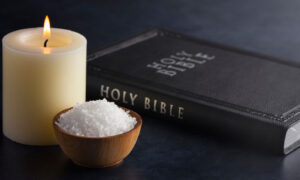
Lots of commentaries focus on what salt is used for. The first and most obvious one to us is as seasoning. Just about everything we cook or bake requires some salt.
A few weeks back I told the beginning of the story “Rush Cape,” from the southern United States, which is sort of a mashup of “Cinderella” and King Lear. In it, you’ll remember, an old king asks his three daughters how much they love him. The older two pour out truckloads of nonsense about gold and jewels and such—because that’s what their minds were on.
The youngest, her father’s favorite, said, “I love you as bread loves salt,” whereupon the king gets angry and banishes her.
If he had ever baked a loaf of bread in his life, he’d have known that you can’t really make bread without salt. Bread without salt is bad. It’s tasteless, doesn’t raise right, and is generally not fit to eat.
When that youngest daughter—whose name isn’t given in the folktale; she eventually gets called “Rush Cape” because that’s what she wears—said she loved her father as bread loves salt, she meant that he was essential, indispensable, in her life.
So if Jesus is saying we are the salt of the earth, what is he saying about our place in this world?
There are a fair number of people out there who stridently insist that humanity would be better off without religion. Many of them are especially critical of Christians. And it’s true that we have sometimes gotten it wrong—very wrong, in many cases. Sometimes we look at things that are actually good and call them evil. Sometimes we look at things that are actually evil and call them good.
But would the world be better off without us? Or would it be like bread without salt?
Think about what has come into this world as a result of the Christian faith: Some of our greatest art and music have been created for the church. Think of the architectural marvels of Notre Dame and other Gothic cathedrals, or the weird beauty of La Sagrada Familia in Barcelona, finally completed this year after more than a century of construction. And even more impactful has been the creation of universities and hospitals, the abolition of slavery throughout Europe and North America, the civil rights movement in the United States—all of which began in the Christian church. Modern science started in monasteries, as the brothers and sisters sought to know more about God by understanding God’s creation.
I’ve heard it said that it was John Wesley’s movement within the Church of England, which eventually came to be known as Methodism, that kept England from going through a French-style revolution in the late 1700s, as industrialization outpaced the recognition that everyone deserved to earn a living wage. Wesley’s “class meetings” weren’t just Bible studies; they were small groups in which people looked after one another spiritually and physically.
But like I said, sometimes we’ve gotten it wrong.
One source of salt Jesus’ original hearers would have been familiar with was the Dead Sea. That salt contains some impurities that can sometimes cause it to go rancid. We most commonly associate rancidity with fats and oils that are old or have been improperly stored, but Dead Sea salt can also go rancid.
Imagine sprinkling a bit of rancid salt over your morning eggs. That’s what it’s like when Christians get it wrong.
It’s no wonder that, these days, some of us have decided not to use the name “Christian.” Instead, we might say we’re Jesus-followers. Okay, but does that fool anyone? I don’t know.
People who are trying to follow Jesus and do the things Jesus taught us to do are refusing to be called “little Christs”—for that’s what Christian means—because some Christians have very publicly gotten it wrong.
And with that we turn to the second of Jesus’ images in this passage for how Christians are to be in this world. “You are the light of the world.”
When I was a kid in Sunday school, we were on what’s come to be called the “Akron plan”: Sunday school departments were grouped by age, and within a department classes were separated by grade level and gender. The classrooms were generally small, opening onto larger rooms where everyone in a particular department gathered at the beginning of the Sunday school hour for a brief time of worship and singing, then went to their little classrooms—third grade boys in one, fourth grade boys in one, third grade girls in one, fourth grade girls in one, for instance—to study the lesson for the day.
In the Middler department at First Baptist Church in Coffeyville, we began our larger-group gathering by lighting two candles, while Miss Nestor played “My Jesus, I Love Thee” on the piano in the corner. As the designated candle lighter—we all eagerly looked forward to our turn—lit the first candle, we all said together, “Jesus said, ‘I am the light of the world,’” referring, of course, to John 8:12. Then when the second candle was lit, we all said, “Jesus said, ‘You are the light of the world,’” as he does in today’s passage from the Sermon on the Mount.
Jesus goes on from there, reminding us that a brightly lit city can’t be hidden—his first hearers would never have conceived of the nighttime satellite photos we have nowadays, where major cities all over the world show up as enormous blobs of light. You just can’t hide that kind of thing.
Jesus brings it to a more immediate setting, though: “You wouldn’t light a candle and then put a bowl over it, would you?” If we refuse to admit we’re Christian because of how some of our fellow Christians have acted, aren’t we doing the same thing?
They get more press, but they’re vastly outnumbered by Christians who are out here doing our best to follow Jesus, to love and serve and heal and lead with kindness and compassion. If we hide our light by refusing to call ourselves Christian, they get the last word.
Instead, we could do what’s right, love God and love our neighbor, and through our acts of love and kindness shine that light into the world, so the world might be a bit less tasteless and a bit more like the kingdom of heaven Jesus came proclaiming.