
Sermons
April 5, 2026 (Easter Sunday)
Walking Through a Fog
John 20:1-18
Because the Sabbath, and not just any Sabbath but the Sabbath of Passover, was coming, the Jewish authorities wanted the bodies down off the crosses as quickly as possible. But crucifixion is a slow and agonizing death, taking at least hours, and sometimes days.
There is a way around that, though: breaking the victim’s legs, so he can no longer push himself up to get a breath. They came around to do that, but Jesus was already dead; so they took him down and gave his body into the care of two formerly secret disciples, Joseph of Arimathea and Nicodemus, the same Pharisee and Sanhedrin member who had visited Jesus by night in John 3. Nicodemus had spices, so the two men used them to prepare Jesus’ body, then wrapped it in clean linen cloths, and laid it in a new tomb that happened to be in a nearby garden.
Then it was over.
The Gospels are silent about what that Sabbath was like.
John’s Gospel, the one from whom we hear today, skips right from Jesus’ burial to Sunday morning. We can only guess what the disciples did Saturday, the day after Jesus died and was buried, the day after the hopes they’d had for a new kingdom of God here on earth were utterly dashed on that skull-shaped rock. They probably lit the candles and said the prayers as the sun set, as observant Jews have done in many times and places over the years. Baruch atta Adonai, Eloheynu, Melech ha-olam…(Blessed are you, Lord our God, Ruler of the Universe, who has made us holy through the commandments and commanded us to kindle the Sabbath light.)
And as the candles were lit, the prayers were said, the meal was served—with unleavened bread, of course, since it was Passover—the familiar ritual may have brought some small comfort, although it may have been, to use Fred Craddock’s evocative words, “a shouted whisper.” Or, in some cases, the disciples may have wanted to scream out, “How can we go on doing the same thing we do every Sabbath, as though nothing had happened?” If they had known Skeeter Davis’ song, it might have come to their minds at this moment:
Why do the birds go on singing?
Why do the stars glow above?
Don’t they know it’s the end of the world?
It ended when I lost your love.[1]
That unleavened bread must have been dry as sawdust in their mouths, the wine that washed it down as sour as vinegar, and whatever of the meal they managed to choke down sat like a stone in their stomachs. Did they even try to sing songs around the table, as they may have done on normal weeks? Or did they just pick at the food in silence, go through the motions of blessing the children and the woman of the house, and finally give up and retreat to their beds to toss and turn the night away?
The next day, being the Sabbath, offered nothing in the way of work that could distract them from the cold reality that the dream they’d shared with Jesus was as dead as he now was.
Perhaps they talked among themselves, gathered here and there around Jerusalem in fearful groups to mourn and say goodbye—for without Jesus, surely there was nothing really to hold them together. As soon as the pilgrimage obligation was over, they would have to go back to their old lives, whatever they had done before they met and were captivated by Jesus. Well, except for the ones who couldn’t go back—Mary Magdalene, now free of the demons that had once plagued her; Nicodemus and Joseph, whose positions of leadership in the Jewish community were gone from them now that they had come out as followers of Jesus; Bartimaeus and other formerly disabled disciples, no longer beggars but too old to learn a trade at their fathers’ sides, as they might have done if not for their disabilities; Matthew the tax collector, surely unwilling to go back to collecting tributes for the Romans who had killed his Teacher and friend. What would they do now?
That day must have seemed a whole lot more than 24 hours long. There was nothing to do but wait it out, think about what had happened. Some people were probably grieving openly, others simply numb.
I wonder if anybody thought to ask, “Has anyone seen Judas?”
And no doubt there were few sorry to see that Sabbath go. Sabbath was usually a delight, a gift, a welcome break from the daily grind of backbreaking work that was life in the ancient world for all but the wealthiest. But not this Sabbath. Hard labor would have been preferable to a day where nothing could be done but sit and think and remember and weep.
As the sun set, the lamps were put out and more prayers said, probably by rote and without their hearts in them. And then there was another sleepless night.
Perhaps it was because she couldn’t sleep that Mary found herself at Jesus’ tomb that Sunday morning before dawn. Perhaps it was because she wasn’t thinking straight that she was out wandering the streets alone at 3 a.m.
This is the way John tells the story, different from the other Gospels, which have Mary Magdalene going to Jesus’ tomb with other women, bearing spices to complete the burial ritual, in one case at least wondering how they would get the heavy stone out of the way so they could do what they needed to do.[2] In John Mary has no particular purpose in mind, and she goes alone, walking through the darkness before dawn in a fog that settled in her mind and her heart.
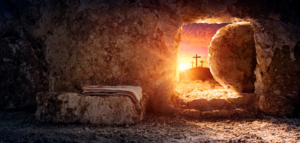
But when she gets there, in the faint light of the coming dawn, she sees that the tomb is open. It doesn’t say that she looks inside, but she puts two and two together when she sees the stone rolled away and the tomb’s entrance dark and gaping.
Unbelievable. It wasn’t enough to have killed him, but now they’ve stolen his body, too?
Peter and the Beloved Disciple came to look also. Peter went into the tomb and saw the grave clothes all lying there—perhaps he realized that grave robbers wouldn’t have taken the time to unwrap a body and neatly fold its wrappings before grabbing it up and getting the heck out of there before they’re caught by the police, or maybe the spirit of the dead one whose final resting place they’d just violated. But he still had no idea what could have happened (in the fog of grief and guilt and fear he might not have remembered the thing Jesus had told them repeatedly but none of them understood at the time), no clue why Jesus’ body wasn’t where it was supposed to be.
Then the Beloved One also went in, and he saw the wrappings, and believed—believed what, exactly? It doesn’t say.
Then Peter and the Beloved Disciple just went home, leaving Mary there, weeping and alone. She looked into the tomb and saw angels sitting there, and then she turned around and saw someone with her!
Naturally she didn’t recognize him—I say “naturally” because even today if we see someone in an unusual setting or wearing unusual clothing if we normally see them, for instance, in a uniform, we don’t always recognize them. That’s normal; and imagine how much more so if the one we see is one who was dead the last time we saw them!
She didn’t know it was Jesus until he spoke her name. Imagine!
Then she went to embrace him, as you would; but he said, “Don’t hold onto me.” She thought she was getting back the same Teacher that she had known before, but everything had changed. Jesus wanted her to know that she could no longer hold onto the way things were before.
Instead, he sent her out—the Greek word is apostello, from which we get the word “apostle.” In John’s Gospel, Mary is the second apostle. (The first was the Samaritan woman in chapter 4, whom Jesus sent to fetch her husband, and since she didn’t have one of those she brought the whole town back to meet Jesus.) Jesus sends Mary to tell the other disciples what has happened and what would happen soon—he who came down, the Word made flesh come to dwell among us, having accomplished what he came to do, would return to God the Father, completing his work and leaving us as witnesses. Witnesses to what, exactly?
Witnesses to an empty tomb, a risen Lord. Witnesses in a world that knows perfectly well such things are impossible. People who aren’t dead don’t come back to life. (Well, they do in zombie movies,[3] but that’s not really much of a life, is it? And that is most assuredly not what happens to Jesus.)
This world knows quite well what happens when somebody dies. It’s final. It’s permanent. Dead is dead, and that is that.
On Saturday, Mary Magdalene, Peter, the Beloved One, and all the disciples knew that. But on Sunday morning Mary saw the impossible, and was sent back to the others to bear witness to it. “I have seen the Lord!” she said.
Unbelievable. That just doesn’t happen…does it?
Well, apparently it did, and before too long others besides Mary saw the Lord, risen and once again walking among us.
Even Paul, though he was not among those original disciples, saw and bore witness to this joyfully impossibly event. And Paul said, “Guess what?” Jesus may have been the first, but he won’t be the last.[4] What happened when God raised Jesus from the dead set in motion a victory against the final enemy, which is death;[5] and one day we will all be raised.
Everything has changed now, even though it seems impossible. We cannot hold onto the way it was before, to the reality that dead was dead, that brutality and violence and oppression and injustice were just the way things are, and the only thing to do was to accept it.
Even though it seems impossible, we stand with the Magdalene as witnesses: we have seen the Lord, the one who could not be kept down by brutality or violence or oppression or injustice, and so we now live according to a different reality. And every day, in our words and in our actions, in the way we respond to the world around us, we bear witness to that seemingly impossible reality. We proclaim to all who see and hear us that justice will roll down like waters,[6] people will one day live free of oppression,[7] the wolf and lamb and calf and lion and poisonous snake and human child will one day live together in peace.[8]
It’s not impossible. It’s Easter.
[1] “The End of the World,” written by Arthur Kent and Sylvia Dee, recorded by Skeeter Davis and released in December of 1962.
[2] Mark 16:3
[3] I’ve actually only seen one zombie movie, Warm Bodies, which makes the case that zombies can be made back into whole, living people through the power of love.
[4] 1 Corinthians 15:20
[5] 1 Corinthians 15:26
[6] Amos 5:24
[7] Isaiah 9:2-7
[8] Isaiah 11:6-9