
Sermons
March 15, 2026 (4th Sunday in Lent)
“Then shall the eyes of the blind be opened…”
John 9:1-41
Once upon a time, I led a group studying the book of Job. It turned out that, the more we dug into the book, the less we enjoyed it. It’s not like the Psalms, where you study one, finish it, and turn to another one. Job is essentially a long argument between the main character and three of his friends, with appearances later from a fourth friend and, at the very end, from God.
The argument gets quite repetitive—although each time one of the characters returns to a subject previously addressed there’s usually a slight change in perspective; and in Job’s case there’s some pretty substantial stuff going on within speeches where he seems at first glance to be saying the same things over and over again. But the main problem in the book of Job is very similar to the main problem in John 9.
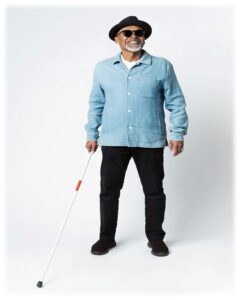
At the beginning of the chapter the disciples ask a question that tells us what they believe the problem is. “This man was born blind,” they say, “and we’ve been taught disability is a punishment for sin. Could he have sinned before he was even born? Or are his parents being punished for their sins by having a blind son, who will never be able to work and earn a living to support them in their old age? We know someone had to have sinned, though, or this man wouldn’t be blind. So who was it?”
It’s sort of hard for us to know just what to do with a passage like this: we like to think we’ve evolved beyond believing that people become ill or are disabled as punishment for sins. Plus, nowadays disabled people are in many cases able to live as full and productive lives as those of us who don’t. Two of the pastors in the e-mail discussion group I was in years ago, for instance, were blind. I have another colleague who is on the autism spectrum; and there is at least one governor in our country who lives with a learning disability.
But if we’re going to understand this text we really do have to put ourselves back in the mindset of the time when the story took place. At that time, a disabled person was a burden on their family, and there really wasn’t anything they could do to support themselves besides begging. Plus, there was definitely the idea, supported by some interpretations of Scripture, that people’s poverty, illness, or disability was the result of their sin. So the disciples’ question was one that made sense in their time and place.
With that said, though, while it might have been a question that made sense, given the givens, Jesus wanted the disciples to start thinking another way. It might be true that some passages in the Hebrew Scriptures appear to support the view that disabilities are punishment for sin, but the Scriptures don’t speak with one voice on this.
When Jesus responds by saying, “This isn’t about sin, but about revealing God’s works,” he might be referring to another tradition, especially within the writings of the prophets. In those texts, the matter of why a person is blind is irrelevant; what’s important is that when a blind person’s sight is restored, it’s about the clearest sign you can get that God is at work. No doubt that’s the reason why each of the four Gospels has at least one story of Jesus opening the eyes of blind people—and one of the four, Matthew, has several, which makes sense given that Matthew’s purpose is to portray Jesus as the fulfillment of prophecy.
So when Jesus put that mud on the blind man’s eyes, he was demonstrating that in him God was at work.
But that’s where the trouble begins, and where we find out that this story isn’t just about one blind man who now can see.
People start talking about what has happened, and then they take the formerly blind man off to the Pharisees, to see if they can offer an interpretation. (Just as an aside, we can’t take the way the Pharisees are portrayed here as an accurate description of how they really were. This is a caricature, a symbol of a particular religious point of view that is found in many places and many faiths, not just within first-century Judaism.) But the Pharisees can’t reach an agreement about just what has happened.
Some of the Pharisees doubt that any miracle has happened: “Maybe he wasn’t really born blind. Maybe he was faking it all along”—as if that was actually a thing, in a culture where being blind meant being totally dependent and economically disadvantaged. So they call in his parents, who confirm that he was indeed born blind, but they won’t say anything about how it is that he can now see. Then when the Pharisees can’t find any good way to explain away what has happened, they turn to the matter of who did it.
It just so happens that the day the man received his sight was the Sabbath. The Sabbath is, of course, a Big Deal, the one thing that, as I mentioned a couple weeks ago, some say has allowed the Jewish people to preserve their identity throughout history. It was commanded by God, clear back at creation, that the Sabbath be a holy day, set apart for worship, study, and rest.
By Jesus’ time, there were a great many rules about what could and could not be done on the Sabbath—what constituted work and what did not, how far a person could walk, whether they could light lamps, that sort of thing.[1]
A person who did not observe the Sabbath was a sinner in the eyes of the Pharisees—and since Jesus had made mud and healed a blind man on the Sabbath, he was not observing it properly and thus was a sinner. But the man who had been blind said he believed Jesus was a prophet, someone through whom God spoke and worked.
But according to the religious tradition, that could not be, because God would not speak and work through a sinner, and Jesus was clearly a sinner since he broke the Sabbath.
This is where we see that the problem in this text is the same as the problem in Job. As our group years ago studied Job, we discovered that the question of why bad things happen isn’t really the main problem in that book.
It’s not in John 9, either, even though that’s where the chapter begins. The controversy that surrounds the healing makes that clear.
Job and all his friends had a particular framework for understanding the world and the events of their lives—what educational psychologists call a schema. This schema came from their religious tradition, perhaps what has come to be known as the deuteronomic tradition—the point of view that informs the book of Deuteronomy and the historical books of Joshua, Judges, 1 & 2 Samuel, and 1 & 2 Kings, along with some of the Wisdom Psalms and the prophet Jeremiah. That tradition says, quite simply, that if you diligently observe all the laws and commandments God has given, and God will bless you with health and prosperity; but disobey and you will be cursed beyond your wildest imaginings.[2]
But then along comes Job, a righteous man—so righteous, in fact, that he even offers sacrifices on behalf of his children, just in case they might have sinned. And then horrible, horrible things happen to him. His children are all killed, his livestock is all carried off, and then he’s afflicted with a skin disease that leaves him unclean, cast out, sitting in the dump scratching himself with a broken piece of pottery.
Job’s three friends come to offer their sympathy and try to help him make sense of the calamity that has fallen upon him. But before too long it becomes evident that what they have to offer—the wisdom of their religious tradition—is not able to speak to Job’s experience. All they can say is, “You have sinned; otherwise this wouldn’t be happening to you. God is just, and if you’d only repent of your sins, God would restore you.”
One of them even says, “The punishment you’ve received is less than you deserve.”
Trouble is, Job knows he’s innocent, and he continues to maintain his claim of innocence even though his friends declare him guilty. And before too long, the friends give up trying to get Job to repent. His experience doesn’t fit with their schema, their understanding of how the world works and how God works. So they have a choice to make: either rethink the schema—which is what Job is doing—or disregard any evidence that doesn’t fit the schema. And they select the latter option.
This, as it turns out, is the same choice facing the religious leaders in John 9.
They know how God works, and they know through whom God works. They knew perfectly well that their own prophetic tradition says it’s a clear sign of God’s work in the world when the eyes of the blind are opened. But they also knew their religious tradition said God does not work through sinners—and since Jesus didn’t observe the Sabbath as diligently as they thought he should, he was a sinner, through whom God does not work.
Yet here’s this formerly blind man, and Jesus is the one who healed him, so we’ve got a case of cognitive dissonance—a situation where the schema is called into question. And so the religious leaders have a choice, the same choice Job and his friends had: either rethink the schema to make room for this new bit of evidence that doesn’t quite fit, or reject that new piece of evidence.
Like Job’s friends, they choose the latter option, and they put the formerly blind man out of the community.
Cognitive dissonance happens whenever something happens that doesn’t fit with the schemas that help us understand how the world works, how God works, what our part is in it all. It happens to everybody at one time or another.
I was talking at one point with a young person, a senior in high school, who was from a Christian tradition that teaches one cannot be both a Christian and a believer in the theory of evolution, a teaching that is often expressed as mistrust of science as a whole. She was taking biology at the time—and biology is the main branch of the sciences where the theory of evolution plays a prominent role.
This young woman discovered that, contrary to what she had been taught at church, biology is not evil. So she was having cognitive dissonance, and she was at a point where she was going to have to rethink how what she’d learned at church and what she was learning at school fit together.
Cognitive dissonance is scary. It throws what we’ve always believed, what we learned from parents, teachers, pastors, everyone, into question. There is risk involved: if this one thing we’ve always believed turns out to be wrong, then maybe it’s all wrong.
But it is through cognitive dissonance that we have the opportunity to grow, to reach new understandings of God, faith, the world and our part in it, new understandings that can help us to make sense of new realities.
We have the same choice at various times in our lives. Do we welcome cognitive dissonance as a gift, and allow us and our relationship with God and the world to be reshaped, or do we shut down that dissonance, holding so tightly to the way it’s always been that we are blinded to God’s breaking into the world in a radically new way?
[1] You might or might not know the story of how a Jewish man invented the Crock-Pot as a way to help observant Jews provide a meal for their families at the close of Sabbath, given that the rules were interpreted to rule out cooking.
[2] See Deuteronomy 28 for an especially dramatic enunciation of this point of view.