
Sermons
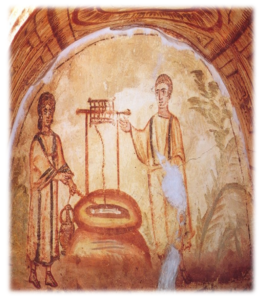
February 8, 2026 (5th Sunday after Epiphany)
An awfully long walk to get a drink
John 4:1-42
My folks used to watch those People’s Court-style judge shows every afternoon. You know what I’m talking about; I think Judge Wapner on The People’s Court was the first one, but he certainly wasn’t the last. A lot of the cases that are dealt with on those shows are pretty minor in the scheme of things, but they’ve managed to break friendships, sometimes even sparked family feuds, when someone has damaged property or taken something that another person thinks belongs to them, or whatever.
I’m sure the cases that are chosen for the programs are chosen because they make for more dramatic television. A case in which somebody came in and said, “I loaned my friend $50 and need it back,” would just be dull. But the one that centers around a scenario like “My roommate moved her boyfriend in and he went in my room and rummaged through my sock drawer,” well, you just want to know what he found in there that was so important to have them all in court now.
And even the “I loaned my friend $50…” case could be interesting if the two parties come in and start hurling accusations and drama at each other during the hearing.
My parents told me they liked to watch these shows because they made them feel superior, and I imagine that may well be true for a lot of people. “My life may be stressful, I may have made some mistakes…but at least I’m not on Judge Joe Brown with my creepy boyfriend who’s been getting into my roommate’s stuff!”
I think a lot of times when we look at folks who are in the midst of scandal or drama, we can be tempted to the same sense of superiority that we have when we watch the folks on the judge shows. And I think it’s the case when we look at the Scriptures, too. Remember the Pharisee and the tax collector in Jesus’ parable? Remember how the Pharisee—who was, in his time and place, considered to be one of the good guys—thanked God that he wasn’t like that tax collector over yonder?
I think we’re like that with people like the woman in today’s story, although in order to do so we have to read a whole lot into the story, because there’s not a whole lot there.
We know she was at the well in the middle of the day. But we don’t know why. We know that she had had five husbands. But we don’t know what happened to them. We know she’s living with a man who isn’t her husband. But we don’t know if he’s a boyfriend, as we’d say nowadays, or maybe her brother or brother-in-law or some other male relative who is supporting her now because a woman in those days had no way to support herself.
We know from how she talks to Jesus that she is reasonably knowledgeable about her people’s religious practices and how they differed from those of the Jewish people. We know she was aware that it was not normal for a Jewish man to be speaking to her and asking her to draw water for him. We know she joined a great many other people in the Fourth Gospel in not completely understanding what Jesus was talking about— “Give me this water,” she says after Jesus speaks of himself as living water; “I’m tired of having to come out here and draw water every day.” And we also know that when she went back to her town and told people she thought she may have just met the Messiah, they followed her out to the well so they could meet him, too.
But it seems like a lot of us preachers get bogged down in the “you have had five husbands, and the one you have now is not your husband” part of the story. Maybe we use the story as a jumping-off place to talk about how Jesus embodied God’s grace, saying to a sinful woman that she was now worthy to be sent out—worthy to be called an apostle.[1] And in order to make the case, we spend a lot of time talking about this woman’s supposedly scandalous lives—sometimes to the point that we’re almost like the Pharisee or the people watching the judge shows, feeling superior to her: “Of course I’ve sinned—everybody has at one time or another—but I’ve never sinned like that.”
Now of course it’s true that Jesus as the embodiment of God’s grace is a major theme throughout John’s Gospel. But I wonder if that’s all there is to this story.
Another theme we find in the Fourth Gospel is that Jesus is, a great deal of the time, talking over people’s heads. He talks in metaphors and symbols that, on their face, say one thing when he means something quite different.
Like in John 3 when Jesus tells Nicodemus, “You must be born again” (or anew, or from above, depending on which translation you’re reading). Nicodemus takes him literally: “I can’t climb back into my mother’s womb!” but Jesus isn’t talking about literal, physical birth.
In the dispute that happens after Jesus feeds a multitude with one kid’s sack lunch, he says that everyone has to eat his flesh to have eternal life—and a whole lot of people say, “eeewww!” and run the other way. But again, Jesus isn’t commanding cannibalism; he’s talking about something else.
In the same way, he is obviously not literally a gate through which sheep pass into and out of their pen. And he is not literally living water that, once a person has drunk some, they’ll never actually have to drink actual water ever again.
People don’t get what Jesus is talking about.
The woman at Jacob’s well didn’t get it, either; but in spite of that—or maybe because of that—she recognized Jesus for who he was. She didn’t totally understand what he was saying, but she still went back to Sychar and told everybody they should “come and see” this strange Jew sitting out at the well: “He cannot be the Messiah, can he?”
Many of us have heard, at one time or another, that people shouldn’t receive Communion if we don’t understand what it means. Most of the time that’s directed at children, with the notion that before a child has learned enough about Jesus to make their own profession of faith and be baptized they don’t understand what the Table is all about.
The problem with that is, if you ask even a preschooler what Communion is, if they’ve been brought to church by their parents or grandparents, they are likely to answer something like, “We eat bread with Jesus.”
Honestly, I suspect our little ones understand a whole lot more about such things than we adults give them credit for—maybe even more than we adults understand. (Keep in mind that Jesus said it is to little children that the kingdom of God belongs, and that if we want to enter in, we must become like little children.)
Not only that, but who among us has a full understanding of what happens at the Table? Communion is a multi-layered event, with lots of meanings, and not one of us can grasp all of it—and for most of us, it means something different every Sunday. Yet we’re all welcome there, because Jesus has made it so.
All this is to say that, just as little children are welcome to meet Jesus at the Table, everybody who understands even a little bit about Jesus, who he is and what he did for us, is not only welcome to come to him, but is also qualified to go out and invite others to “come and see” this one who offers abundant and eternal life.
[1] Apostle is a direct transliteration of a Greek word that means sent out.