
Sermons
January 18, 2026 (2nd Sunday after Epiphany)
Show me, don’t tell me.[1]
John 2:1-11
If you were going to do something that demonstrates how spectacular you are, how talented, maybe even how tuned in you are to God, where would you do it? Wouldn’t you want to do it in front of lots of people, maybe at a special event? You wouldn’t do it in a back room where literally nobody knows about it other than some servants and a few of your friends, would you?
In John’s Gospel Jesus is fully aware that he is the Son of God, and rarely passes up an opportunity to let folks know it.
That’s in contrast to the other three, the Synoptic Gospels, in which we find something Bible scholars call the “Messianic Secret.” Jesus might know who he is, but any time anybody else figures it out, he tells them to keep it to themselves. Even when Peter confessed, “You are the Christ, the Son of the living God,” he ordered the disciples not to say anything to anyone else about it.[1] In the Fourth Gospel, Jesus doesn’t keep this a secret or ask anybody to keep it secret. (That rarely works in the Synoptic Gospels, anyway; people are always running out and telling others about their encounters with Jesus.)
Yet this first of Jesus’ miracles, as church tradition calls them, or in the Fourth Gospel the first sign (the difference is important, and I’ll get to it momentarily) happens in a place and in a way that is very nearly invisible.
People love to speculate about whose wedding this was that Jesus, his mother, and his disciples were invited to. Michael Card suggests it might be Nathanael’s wedding—we met Nathanael last week; he’s the one who, when told about Jesus, said, “Can anything good come out of Nazareth?” He bases that on this story having come right after Jesus’ first conversation with Nathanael, and the fact that later in the story we learn Nathanael was from Cana.[2]
Or maybe it was a relative of Jesus and Mary, or another of the disciples, or…well, who knows? And really, it might be a fun diversion to discuss that, but it’s not the point of the story.
Over the course of the multi-day wedding celebration, the wine runs out. That’s a major social faux pas (or forepaw, as I once heard some old-timer in a cowboy show say) and an embarrassment for the family throwing the party. Twenty or thirty years down the road folks in that small town might have still whispered to one another, “Remember when the wine ran out halfway through Micah and Rachel’s wedding?”
Mary must have had some connection to the folks throwing the party to have been concerned about it. She went to Jesus and told him what was going on. Notice she doesn’t say to Jesus, “Go fix it.” But you know she had that in the back of her mind, so it was implied when she said to Jesus, “They have no wine.”
He initially backtalks her. “How is that my problem? This isn’t the time for me to be revealed to everybody.”
But again, there’s a lot going on between the lines, because Mary knows he will do something. She believes he can, and she believes he will be similarly concerned to make sure the family involved isn’t put to shame. So she goes to the servants and says, “Do whatever my son says to do.”
In an alcove or something, there were six huge stone jars meant to hold water for ritual washing of hands and feet. He tells the servants to fill the jars with water—presumably all the hands and feet had been washed at that point, since the jars were empty—and then put some in a glass for the maître d’ to taste, so he would know they’d gotten hold of some more wine.
That man is surprised to find that the best wine had been saved until the other wine had run out, completely backwards to the way it was usually done. But he doesn’t seem to have any idea where the wine has come from; the servants don’t seem to have told him even though they surely know what’s happened.
At this point the narrator breaks in and explains that this was the first of Jesus’ signs, which revealed his glory. And he says that as a result of this sign, “his disciples believed in him.”
I’m not sure what that means; I would have assumed they already believed in him, to some extent, at least, because they had left their previous teacher John the Baptist, or their previous lives, and were following Jesus. Or maybe “believing in Jesus” isn’t something that happens all at once; we have a little bit of belief that leads us to step onto that path, but over the course of our lives with Jesus we learn more and more and believe more and more.
But why signs? Why not miracles? The other Gospels don’t speak of signs.
Well, it’s one of the things that makes the Fourth Gospel unique. There are seven of these signs, with the one in today’s story being the first. We’ll look at the others in their time.
Oddly, just about all of them are sort of behind the scenes or invisible, or done at a distance, until we come to the seventh one, which is the raising of Lazarus from the dead.
Why are they signs and not miracles? It’s because of the purpose John gives us, finally, toward the end of the Gospel: “…these [things] are written so that you may come to believe that Jesus is the Messiah, the Son of God, and that through believing you may have life in his name.”[3] The purpose of the signs might on the surface be to solve someone’s problem—to help a family avoid social shame by providing an abundance of wine, to heal someone who was sick or blind, to feed people who were hungry, to return someone who has died to the family who depended on him. They certainly did that, but there was a deeper purpose: to show folks who Jesus was.
In the case of this first sign, you have to know what wine signified in the Hebrew Bible, particularly in the Prophets.
We just moments ago read responsively a passage from the very end of Amos, in which, in a new age that is surely coming, “the mountains shall drip sweet wine, and all the hills shall flow with it.” (Kind of brings to mind the line in “The Big Rock Candy Mountains”—a description of hobo heaven—where “the little streams of alcohol come trickling down the rocks.”[4] But the prophetic imagery isn’t meant to be a prediction that potentially addicted hobos will have their cravings met.)
There is a similar passage in the book of the prophet Joel:
In that day
the mountains shall drip sweet wine,
the hills shall flow with milk,
and all the stream beds of Judah
shall flow with water;
a fountain shall come forth from the house of the Lord
and water the Wadi Shittim.[5]
Both are predictions of the “Day of the Lord,” when God does away with all sin and unfaithfulness and vanquishes the enemies of God’s people, ushering in an eternity of peace and plenty.
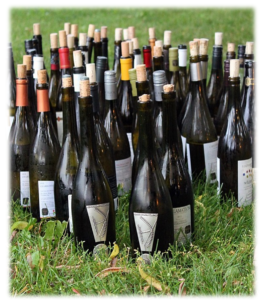
So when Jesus changes water to the best wine the steward has ever tasted—and not just a little bit of wine, but the equivalent of several hundred of our modern bottles of wine—it’s a sign, the Fourth Gospel’s way of showing us, rather than telling us, that in Jesus the Day of the Lord, the Reign of God, is here.
When I took creative writing in college, one of the main rules was, as my sermon title says, “Show me, don’t tell me.”
In other words, if I had a character in a story who was stuck up and entitled, it would land a lot more effectively if, rather than simply saying, “Goldilocks was stuck up and entitled,” I said, “Goldilocks treated everyone she met like they existed solely to serve her; she wore a permanent scowl, as if she was perpetually smelling something noxious, and her six favorite words were, ‘Let me speak to your manager.’”
We can go out into the world and say, until we’re blue in the face, “I’m a Christian,” but is it possible that our witness would be more effective if, rather than telling everyone how Christian we are, we let it be demonstrated through acts of kindness, words of encouragement, and love for our neighbors?
[1] This seems to be the second sermon I have written with this title. The other one was for Sac City and is based on the story of Thomas in John 20.
[2] Matthew 16:13-20; see also Mark 8:27-30; Luke 9:18-22.
[3] John 21:2; he was one of the disciples who were fishing with Peter and saw Jesus on the beach.
[4] John 20:31
[5] Harry McClintock wrote “The Big Rock Candy Mountains” in 1895, but he didn’t record and copyright it until 1928. The imagery in the song reminds one of the medieval stories of a mythical place called Cockaigne, a sort of paradise where all the hardships of peasant life were replaced by abundance and enjoyment. https://en.wikipedia.org/wiki/The_Big_Rock_Candy_Mountains.
[6] Joel 3:18