
Sermons
October 19, 2025 (Proper 24)
Second Guessing History
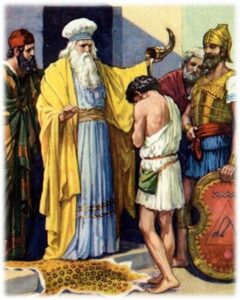
1 Samuel 16:1-13
Did you ever notice that there are some people in your life who you like better and better the more you get to know them? And the converse is true, too: there are people we dislike more and more the longer we know them.
King David is like that for me.
I know he’s supposed to have been the greatest king Israel ever knew, that he was a king “after God’s own heart”—which probably means something like he was loyal to God—that he is thought to have written the Psalms (I will give him the 23rd, but I don’t think it’s possible he wrote all of them, and the Psalms themselves don’t make the claim they were all from David’s hand). But he just doesn’t do it for me.
It’s not just the business with Bathsheba that leads me to dislike David. That’s a big part of it, of course: David, having gotten a little too comfortable on his throne, decided he didn’t need to ride out with his army, as kings always did up until the time of modern warfare. And that got him into trouble, as he went up on his roof and was a peeping tom on the mikvah in the middle of town, where a woman, observing the Law of Moses, was performing a ritual bath after…err…her time of the month.
He shouldn’t have been in the palace in the first place, and he sure shouldn’t have been up there gawking at a naked woman doing what she was required to do according to God’s Law.
This was no great love story, certainly wasn’t a situation in which Bathsheba was somehow “asking for it” or trying to seduce the king. It was a powerful man who was where he wasn’t supposed to be, using another human being for his own gratification and then throwing her away like a used napkin. He never even spoke to her, according to the story![1]
And Bathsheba wasn’t the first time David had taken another man’s wife for his own. The first one was Abigail, wife of Nabal the Calebite.[2]
And then there’s the heartbreaking story of David’s first wife, Michal, daughter of Saul. She genuinely loved David, and Saul allowed their marriage; but then when David rebelled against Saul, Saul took her from David and gave her to a man named Palti (or Paltiel) son of Laish.[3] Then, once David has defeated Saul and his supporters, he demands that Michal be taken from Palti and returned to him. By that point Palti and Michal had been together for quite awhile, and genuinely loved one another.[4]
It’s no wonder she was a little peevish when she observed David dancing half naked in the streets as he brought the Ark of the Covenant into Jerusalem.[5] She’d been yanked and dragged from one man to another her whole life, with hardly anybody bothering to think about what she might have wanted.
It’s not all David’s fault, but he sure had a hand in it.
I just don’t like King David. “Man after God’s own heart” or not, he lived up to the warning Samuel had given the people clear back when Israel demanded a king, after which they ended up with Saul.[6] “These will be the ways of the king who will reign over you: he will take…he will take…he will take…he will take…he will take…he will take.”
Saul may not have been a great king, and he disobeyed God to the point that God decided to depose him (although Saul reigned for a great many years, through growing madness and incapacity, after Samuel anointed David). But David wasn’t exactly a paragon of virtue himself. And after the incident with Bathsheba, there was a rebellion among his sons—including the aftermath of one of them assaulting his own half-sister!
Ultimately his son with Bathsheba, Solomon, became king after him. We’ll learn more about him next week.
One of my college history teachers said that when he was in college, someone in the class asked the professor to weigh in on how things would have been different if some historical event (I forget which one) had not happened. And the professor straightened up and said, “We do not deal in ‘what-ifses.’ We deal in ‘what was-es.”
But lots of people have done a lot of writing about “what-ifses,” as that professor said. I remember running across a book in the library at Wichita State whose whole premise was thought experiments about various events in history. There was a novel written 20 years ago by Philip Roth in which he imagines how his Jewish family would have fared had Charles Lindbergh defeated FDR in the 1940 presidential election and signed a treaty with Hitler.[7]
“What-ifses” are sort of interesting. But some take that a step further, and evaluate the decisions made in the past from the lofty position of hindsight. Well, King So-and-So shouldn’t have done x, because y and z happened as a result. But could King So-and-So have predicted what happened afterward? He didn’t have the benefit of hindsight.
That’s why my Disciples history teacher, who had been our regional minister until he had to retire, said he believed it was a mistake to second-guess history. In the midst of an event, people make decisions that turn out to be good or bad, based on what they know and believe at that moment. In the rear-view mirror we can see the consequences of those decisions, but the ones making the decisions couldn’t have predicted all the possible outcomes.
Even so, it’s tempting, especially when we run across a historical figure who might have been revered in his time, but looking back we can see so many problems. Like David.
What if Saul had behaved himself, and not lost God’s support?
What if Israel had not become lawless under the judges and then demanded a king?
What if the king to replace Saul had been someone other than David?
What if David hadn’t done what he did to Bathsheba?
And why, given that God does know everything and can see the consequences of the choices humans make, did God choose David over all the other people in Israel, including his seven older brothers?
We can’t really answer those questions, beyond spending time on thought experiments that don’t actually do a whole lot for us.
If we can’t second-guess the story of David, Samuel, Saul, and everybody else who was involved in that whole mess, then what do we do with it?
The most important thing to ask of any Bible passage we might read, whether it’s creation, the anointing of David, the book of Revelation, or whatever, is, “Where is the good news in this passage?”
Remember that we have four books in our Bible that are explicitly called “good news”—the Old English word is gospel. The good news there is Jesus Christ and what God has done for us through his life, death, and resurrection.
We don’t have to read every passage in the Old Testament with an eye toward what it says about Jesus in order to find some good news in it. David’s story does say something about Jesus, though, because David is Jesus’ ancestor, and Jesus’ followers came to interpret his story based on the messianic hope of Jesus’ people that a “son of David” would one day retake David’s throne and reign there forever. Had God chosen someone other than David, or had Saul turned out better, or whatever other direction our thought experiments might go, there would have been a different family tree leading to God’s own Son taking on flesh and walking the earth.
But is that the only good news in David’s story?
Consider the following. David was chosen to be “a man after God’s own heart” (the phrase originally comes from 1 Samuel 13:14), and even though he was extremely flawed as a human being, God remained with him and with his descendants, until Babylon ended the Davidic dynasty—but the people continued to hope for a new descendant of David to be their king once again, clear up to the days of Jesus. So I wonder if one bit of good news in the story could be that God chooses even flawed people to serve God and lead God’s people, in whatever capacity.
If you are sitting here today hearing a call to some kind of ministry or service, but you are sure that can’t have come from God because God knows who you are and what you are, then David’s story could be instructive. If God could call David, and make promises to David that eventually led to Jesus, what makes you think your flaws, whatever they may be, disqualify you from serving God?
[1] See 2 Samuel 11—12 for the whole story, which is not sanitized for our protection.
[2] See 1 Samuel 25 for the story of Abigail, David, and Nabal.
[3] David and Michal are married soon after the Goliath incident; see 1 Samuel 18:20-29. It seems that Saul’s jealousy of Michal’s love for David may have been what soured the two men’s relationship. Palti enters the picture right after David marries Abigail and another woman, Ahinoam of Jezreel, in 1 Samuel 26:43-44.
[4] 2 Samuel 3:12-16
[5] 2 Samuel 6
[6] 1 Samuel 8
[7] The Plot Against America (2004).