
Sermons
August 24, 2025 (Proper 16)
Circular Arguments
1 Timothy 3:16-17
When I was in the high school band, our director had a sign above his office door. It was a list of rules—a very short list, as it turned out.
Rule number 1: The director is always right.
Rule number 2: If the director is wrong, see rule 1.
Sort of a circular argument, really, although I don’t think it’s exactly what is meant when someone points out that particular logical fallacy.
A circular argument is one in which the conclusion is basically a restatement of the original premise.
Here’s an example from the “Helpful Professor” website: “People forget how dangerous driving can be. We are all racing around in cars every day. But, because we are all doing it, we forget how dangerous it is.”[1] Seems obvious, of course; but there just really isn’t anything there.
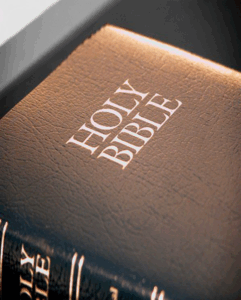
Today’s question is whether the doctrine of the inerrancy of Scripture is found in the Bible. And honestly, that might be the wrong question, because most arguments about it are based on circular reasoning, but they appeal to the Bible itself for support. In other words, “The Bible is inerrant because the Bible says it’s inerrant, and since the Bible is inerrant it must be true.”
I guess we need to start with what inerrancy even means. Most Christians who believe in the doctrine of inerrancy say that it means every word in the Bible is absolutely, literally, factually true. If the Bible and modern science contradict each other, for instance, the Bible wins the argument.
But here’s a problem we have to grapple with: Which Bible is inerrant? The Bible as we have it today in English? The King James Version, published 400 years ago? What about Bibles that aren’t in English? Are they inerrant?
Plus which, remember that the Bible was originally written in ancient languages that aren’t spoken anymore: ancient Hebrew, koine Greek, and a little bit of the book of Daniel in Aramaic, which was probably the primary language of Jesus and his original disciples.
So folks will say, well, okay, the original manuscripts are inerrant. That’s a tidy way to dispose of the whole business, since we do not have any of the original manuscripts of anything in the Bible. The oldest manuscripts we have are copies of copies.
Or maybe they’ll argue that God has been at work at every stage of development, from original manuscripts to copies to translations, and God has kept all of them free from error. The only problem is, it doesn’t take long to realize that the oldest manuscripts we have don’t always agree; some things can’t be translated well from one language into another—like the three words in New Testament Greek that all have to be rendered with one English word, love—and language changes over time.
All of these are why one of my seminary professors—by no means a liberal—declared inerrancy to be “a doctrine that has died the death of a thousand qualifications.” And it’s not necessarily true that if we don’t believe in inerrancy, we deny that the Bible has any authority in the life of believers and of the church.
Let’s look at the matter a bit more closely, starting with the reality that our passage for today actually says two things about the Bible: first, that it’s “inspired by God”—or, in the King James version, “God-breathed”—and second, that it’s “useful” for several tasks involved in making and educating disciples of Jesus.
Some circles of the church are more comfortable answering the question of what it means that the Bible is “inspired by God” than they are in explaining its usefulness. We might appeal to the King James translation, which I mentioned above, of the strange Greek word that shows up in the verse: theopneustos, which King James renders as “God-breathed.” Newer versions like the NRSV say “inspired by God,” and both are accurate translations, because theopneustos is a compound word made of theos, God, and a derivative of pneuma, which can mean spirit, or wind, or breath.
Language changes over time, as anybody who’s ever tried to read Shakespeare’s plays and poems—which are roughly contemporary with the King James Bible—knows. In 1611, “God-breathed” may have meant something different from what it came to mean in the modern era.
When many 19th– and 20th– and even 21st-century Christians heard the term “God-breathed,” they might have imagined God speaking the words and the authors of the Bible simply writing down what God said. Carried to an extreme we might picture God as being like an old-style CEO in a corner office, behind a desk, dictating the words of Scripture to a secretary, telling the secretary every word to use, even what punctuation to put where.[2]
There are problems with this.
Did God “breathe” the words of the 137th Psalm, the one that ends with the words, “Happy shall they be who take your little ones and dash them against the rock”? Were those the actual words of God, or a cry of agony from God’s people who have been violently taken from their homes and carried into exile?
Or what about the four Gospel accounts of the death and resurrection of Jesus (not to mention Paul’s account in 1 Corinthians 15, which was probably written down years before the Gospels), which don’t agree on every detail?
The Bible is made up of a number of different kinds of writing: there’s law, poetry, liturgy, history, letters, apocalyptic literature—weird and beautiful in its own way—and prophetic writings. Only a couple of these can truly be considered “God-breathed” in the sense of God saying it and a human being repeating it or writing it down.
We see it in the books of the prophets, when, for instance, Jeremiah, prefaces something with “The word of the Lord came to me, saying…” In the prophetic writings we often have God portrayed as speaking directly to a prophet, who then relays the message to God’s people. In many places in the Torah, the first five books of the Bible, God is shown speaking directly to the people—as in the giving of the Ten Commandments—or to Moses, who passes God’s instruction on to them.
But in other parts of the Bible?
Look at Luke and Acts, for instance: the author of those two books is pretty clear about what he’s doing, and it’s not recording God’s actual words. Luke isn’t a prophet; he’s a researcher. He has a number of sources at his disposal, including stories about Jesus’ life, ministry, death, and resurrection; collections of Jesus’ teachings; and stories about the life and work of the first apostles, including Peter and Paul. His chosen task is to put them together in a single “orderly account.”[3]
So are Luke and Acts “God-breathed”? Not exactly. Is Luke “inspired by God”? Definitely.
But can we say, as some do, that “inspired by God” is a weaker statement than “God-breathed”? Is it true, as some argue, that if God didn’t literally speak every one of the words in the Bible, then none of it is true and we have to throw it all out? Is it fair to say that if the Bible is not factually accurate in every part—including the parts that seem to contradict the current thinking of scientists—it has no authority whatsoever?
If those statements are true, then we have got to defend forcefully the inerrancy of Scripture. We have to stand firmly against such ideas as the theory of evolution, which seems to contradict what the Bible says in Genesis 1. We must devote scientific thought to the matter of proving everything in the Bible really happened as it’s written there, from Genesis 1 to the story of Noah’s ark to whether Jonah really got swallowed by a great fish and spit out three days later, and even the weird story in Joshua about God making the sun stand still until the Israelites won a decisive battle.[4]
But in doing that, I think we’re asking of the Bible something it never claimed for itself.
I like what the late, controversial Canadian theologian Clark Pinnock said about the Bible’s inspiration, actually. Alluding to Paul’s words in 2 Corinthians 4:7 about “treasure in clay jars,” Dr. Pinnock says: “The Bible is a rich treasure, the word of God, mediated to us in a human vehicle and capable of being, in the power of the Spirit, the place where we can hear God speak to us today.”[5]
What Dr. Pinnock says here points us toward the second statement about the Bible in today’s reading—and that second statement, I would argue, is much more important than the first.
Arguing about inerrancy, about whether or not Jonah really got swallowed by a whale,[6] or about whether or not God actually dictated every word of the Bible—that stuff, in the words of another of my seminary professors, “won’t preach”; it doesn’t help us understand God’s will for our lives, and it doesn’t win over folks who are not yet followers of Jesus. But it’s another matter when we let the Bible be useful.
Of course we don’t leave aside the idea that Scripture is inspired by God—but we recognize that inspiration is a whole lot more than simply whether the words are written down exactly as God spoke them. The two notions go hand in hand: it’s because the Bible is inspired, because the Holy Spirit is at work in our hearts and minds whenever we read or study the Scriptures, that it’s useful for helping us grow into more faithful disciples of Jesus, and for helping us make more disciples and teach them everything he taught us.
[1] https://helpfulprofessor.com/circular-reasoning-fallacy-examples/
[2] Let’s ignore for the moment the fact that the oldest Biblical manuscripts contain no punctuation at all!
[3] Luke 1:1-4
[4] Joshua 13:1-15
[5] This quote comes from a 1980 article by Pinnock in Sojourners magazine, which may be found at https://sojo.net/magazine/october-1980/treasure-earthen-vessels.
[6] Whether or not one believes this really happened, the fact of the matter is that (a) the book of Jonah says it was a “big fish,” not a whale; and (b) whales are not anatomically able to swallow something as large as a human being.